_edited.png)
Sustainable Sportswear: The Real Cost of Our Kit
Runners, by nature, are romantics. We chase sunrise miles, quiet roads, empty trails. We talk about freedom, simplicity, stripping things back. And yet, most of us do it wrapped head to toe in synthetic fabrics made from oil — garments designed to be replaced, refreshed and rebranded every season.

The contradiction is hard to ignore. A sport so closely associated with nature, health and longevity has become deeply entangled with one of the most extractive, waste-heavy industries on the planet.
Sportswear is sold to us as progress. Lighter. Faster. More breathable. More “technical”. But what happens when innovation becomes indistinguishable from novelty — and performance becomes a justification for excess?
To understand how we got here, and whether there’s a way forward that doesn’t involve moralising or abstinence, we spoke to Patrick Grant — designer, manufacturer, and one of the clearest voices on what’s actually happening behind the scenes of modern clothing production.
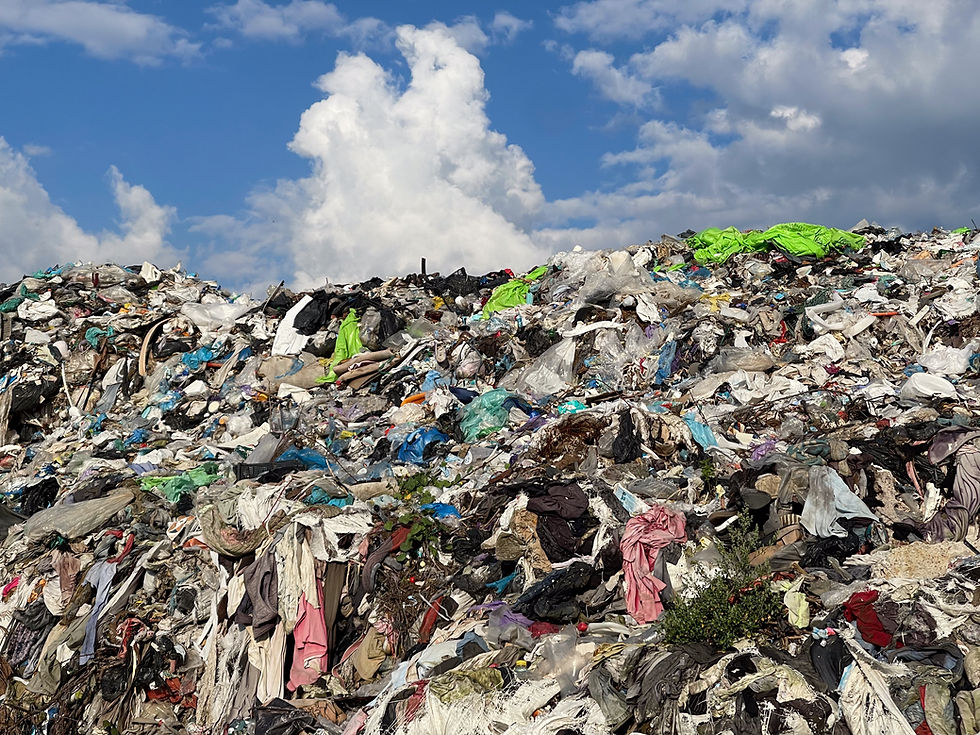
The mountain we don’t see
Globally, the clothing industry produces somewhere between 80 and 150 billion garments every year. According to The Guardian, as much as 40% of clothing produced is never sold, much of it incinerated, exported or buried without ever being worn. That equates to tens of billions of garments annually that never fulfil their intended purpose.
One statistic, often cited by Grant and referenced by industry bodies including the British Fashion Council, is especially difficult to ignore: there is already enough clothing in circulation to clothe the next six generations.
“We’re not dealing with a shortage problem,” Grant says. “We’re dealing with a scale problem.”
Sportswear plays a significant role in this excess. Much of it is made from blended synthetic fibres — polyester, nylon, elastane — designed for stretch, moisture-wicking and compression. These garments are extremely difficult to recycle at scale, shed microplastics with every wash, and do not biodegrade.
“None of this is ever going away,” Grant says, bluntly. “Once these clothes exist, they exist forever. We’ve created materials that don’t return to the earth, and we keep making more of them.”
Why running is especially vulnerable to hype
Running, on the surface, is one of the most accessible sports there is. You don’t need much to begin. And yet it has become one of the most aggressively marketed categories in modern sport.
Part of this is identity. Runners don’t just run — they are runners. Shoes, kit and brands become shorthand for seriousness, belonging and intent. Part of it is optimisation culture.
Running promises measurable progress. Marginal gains feel tangible. And brands are quick to suggest that the next upgrade — the next fabric, the next drop — might be the thing that tips the balance.
Social media accelerates the cycle. Influencers rotate outfits daily. New colourways appear weekly. What was “essential” last season is suddenly obsolete. “It’s relentless,” Grant says. “People have been co-opted into selling stuff. The world has gone selling-mad.”
Innovation vs novelty
There is no denying that genuine innovation exists in sport. Better training knowledge, smarter recovery tools and improved footwear design have changed performance for the better. But, Grant says, “the idea that performance lives in fabric is a very profitable myth.” Innovation has quietly become confused with novelty.
Seb Coe won Olympic gold in cotton kit. Roger Bannister broke the first sub-four-minute mile in leather shoes. Performance was never dependent on oil-derived fabrics. “The benefits of wearing synthetics versus non-synthetics are very small for most people,” Grant continues. “And the environmental and human cost of that tiny benefit is very high.”
For the vast majority of runners, shaving a few seconds off a parkrun time is not worth the long-term impact of garments that will never break down.
“This is the choice,” Grant says. “You might shave a fraction of a second off your time — but how much happier are you going to be when you consider the consequences of what that kit is made from?”

Overproduction without transparency
A powerful intervention in this space comes from The Or Foundation, a Ghana-based organisation working at the frontline of the global clothing waste crisis. Their campaign, Speak Volumes, calls on brands to publicly disclose their annual production numbers — a basic data point that almost all brands already have, yet rarely share.
Production volumes matter because they expose the true scale of overproduction. They show how much is made versus how much is sold. And they force uncomfortable questions about what happens to the rest. Grant recalls speaking with an EU sustainability official who described stockpiles of unsellable sportswear already worth billions — and growing. “These guys are just pumping stuff out at a crazy rate,” he says. “It’s not good for anyone except shareholders.”
A quieter model
Much of what’s sold as “sustainable” sportswear simply isn’t — at least not in the way consumers are led to believe.
Bamboo fabrics are often bamboo in name only, processed into viscose using intensive chemical treatments. Recycled polyester delays landfill rather than preventing it, especially when there’s no closed-loop system to recycle it again. Blended fabrics — elastane mixed with nylon, polyester with coatings — are functionally unrecyclable. The uncomfortable truth is that the most sustainable garment is usually the one that already exists. Buying less. Wearing longer. Choosing pieces that don’t rely on constant upgrading.
These aren’t radical ideas — they’re just commercially inconvenient.
Choice, not control
Running teaches patience. Long-term thinking. Respect for process. It asks us to consider impact over time — not instant reward.
Perhaps the next evolution in performance isn’t another fabric innovation, but a shift in mindset: less noise, fewer drops, more intention. This isn’t a call to stop buying sportswear, or to strip running of joy, style or self-expression. Clothing matters. Identity matters. Feeling good in what you wear matters. But choice requires honesty.
“Do you want to run in a way that f***s the planet,” Grant asks, “or in a way that’s positive for everyone involved?” It’s a stark framing — but it cuts through the noise. Because the cost of our kit isn’t just what we pay at checkout. It’s what we leave behind.
Learn more at theor.org & communityclothing.co.uk


Comments